

OUR APPROACH
Measure. Model. Reduce Pressure. Evaluate. Restore
The Port Royal Sound Living Shoreline / Smart Reef Initiative is built around an adaptive sequence. First, researchers characterize the shoreline and the forces acting on it. Next, a high-resolution hydrodynamic model is used to test configurations intended to reduce erosion. Field installations are then monitored to determine how the shoreline responds. Where erosional pressure is sufficiently moderated, additional living-shoreline strategies can be tailored to support recovery.
1. Measure
2. Model
3. Reduce pressure
4. Evaluate
5. restore
Beneficial Reuse of Concrete Barriers
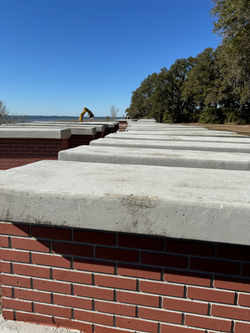
Parris Island had existing concrete transportation barriers available for repurposing. Rather than treating them simply as disposal material or placing them offshore where they would not meaningfully reduce shoreline erosion, the project used site measurements and modeling to position suitable barriers in the intertidal zone as a living shoreline of scale.
The design goals are to reduce erosional pressure on the revetment, slow further lowering of the mid-intertidal zone, help stabilize remaining marsh patches, provide structure for an integrated observing system, and create habitat while testing complementary Bio-Rock techniques.
 |  |  |  |
|---|---|---|---|
 |  |  |  |
 |  |  |  |
 |
Smart Reef / Bio-Rock Research
Bio-Rock uses a low-voltage direct current in seawater to precipitate calcium carbonate — the same basic mineral material found in shells. The project is testing whether this process can strengthen or biologically enhance shoreline structures and whether the electrical field can improve recruitment and growth of organisms such as oysters and barnacles.
The research remains experimental. Different power sources, electrode materials, distances, elevations, and tidal immersion periods are being evaluated to understand where the process may provide useful benefits.


